
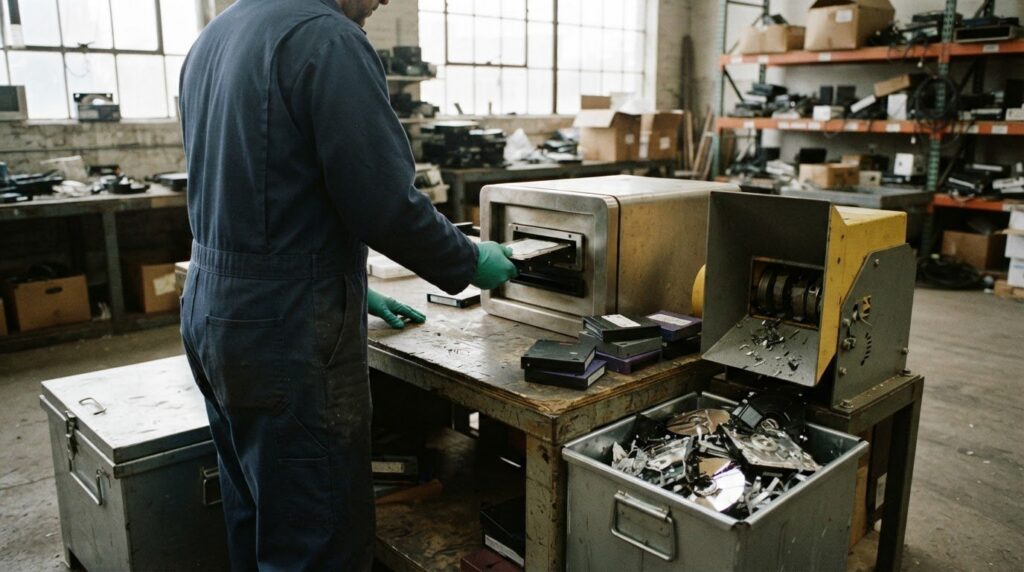
Physical destruction isn’t the only way to make stored data unusable. The choice between degaussing and mechanical shredding for magnetic storage media depends on the device and whether you need to keep its hardware intact: degaussing disrupts data on magnetic media, while shredding breaks the device into pieces. Neither method leaves the media ready for reuse.
It’s understandable to want a clear, secure way to retire hard drives and tapes without creating unnecessary waste. This guide explains what degaussing does, why it doesn’t work on flash storage such as USB drives or memory cards, and how it compares with shredding and data wiping. You’ll learn which method may suit magnetic drives, tapes, flash devices and equipment intended for reuse, helping you make a practical choice for secure data handling and responsible electronics recycling.
Key Takeaways
- Match the method to the storage type: degaussing targets magnetic media, while shredding can destroy magnetic and flash devices.
- Choose wiping when a working device may be reused, and consider physical destruction when it must not remain usable.
- For degaussing, the strength of the magnetic field must be suited to the media’s coercivity for the process to work effectively.
- Destruction records can help document the method used and support accountable handling of retired media.
Does Degaussing Destroy a Hard Drive?
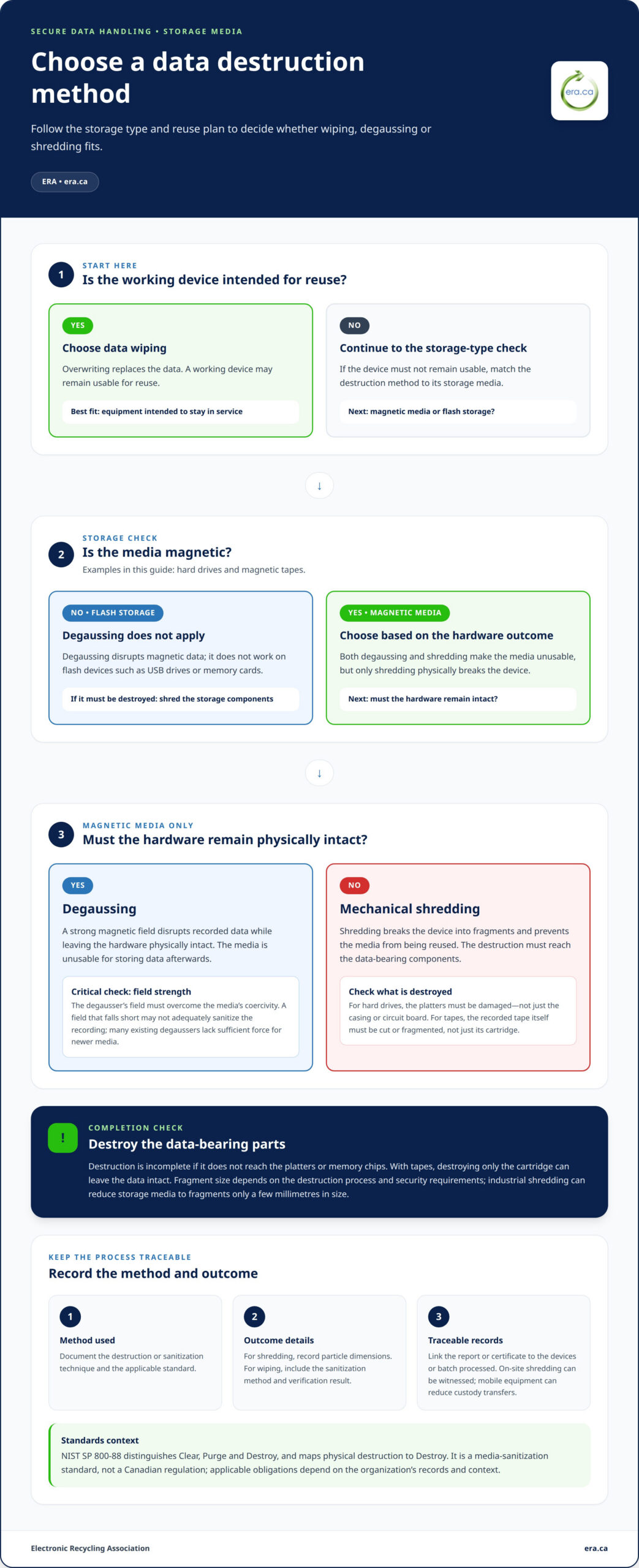
Degaussing makes a hard drive unusable by disrupting its magnetic data, but leaves the hardware physically intact. Mechanical shredding breaks the drive into fragments, preventing the media from being reused. With either method, destruction is incomplete if it fails to reach the data-bearing platters or memory chips.
Industrial shredding can reduce storage media to fragments only a few millimetres in size. For magnetic tapes, the recorded medium itself must be destroyed; breaking only the cartridge would leave the data intact. The appropriate fragment size depends on the destruction process and security requirements, rather than one size that applies to every device.
For Canadian organizations, NIST SP 800-88 provides a technical framework, distinguishing Clear, Purge and Destroy. It maps physical destruction to Destroy, but is a media-sanitization standard, not a Canadian regulation. Applicable obligations depend on the organization’s records and context.
| Method | Media outcome | Useful report details |
|---|---|---|
| Degaussing | Magnetic media becomes unusable; hardware remains intact | Technique and applicable standard |
| Mechanical shredding | Media is reduced to fragments | Technique and particle dimensions |
| Wiping | Data is overwritten; device may remain usable | Sanitization method and verification result |
A verification report or certificate of destruction supports an audit trail. It should record the destruction method, particle dimensions when shredding is used, and applicable standards. Link records to the devices or batch processed so your organization can trace what was destroyed and how. On-site shredding allows staff to witness the process, while mobile equipment can reduce custody transfers.
Typical Canadian prices for hard-drive degaussing and shredding vary with media type, quantity and logistics. The price depends on the case and is given after a quote request.
Choose degaussing when magnetic media must be rendered unusable without being physically broken. Choose shredding when the hardware must be physically destroyed, and keep records documenting the method and outcome.
Data wiping vs shredding vs degaussing: which method is right for you?
Choose based on storage type, reuse plans and the evidence your process requires. Degaussing disrupts magnetic data, overwriting replaces it, and shredding reduces hardware to pieces.
Degaussing Magnetic Data
Magnetic drives encode information through the orientation of tiny magnetic domains on their platters. A strong reverse magnetic field disrupts those orientations, leaving the original data no longer readable through normal drive operation. Unlike overwriting, degaussing doesn’t write replacement information to each address. Unlike shredding, it leaves the physical drive intact, but unusable for storing data.
The deciding factor is whether the degausser’s field can overcome the media’s coercivity. The National Institute of Standards and Technology notes that many existing degaussers lack sufficient force for newer media. Degaussing applies only to magnetic storage, not flash devices.
Data Security and Compliance
Overwriting may suit a working drive intended for reuse, while shredding physically destroys the media. A secure process should match its method to the device and preserve records of what happened. NIST SP 800-88 distinguishes Clear, Purge and Destroy sanitization levels, helping organizations describe the approach in their documentation.
UK GDPR and the Data Protection Act 2018 concern UK data protection, while the Waste Electrical and Electronic Equipment Regulations 2013 address UK electronic waste. These are UK frameworks, not Canadian rules. Canadian organizations should base compliance decisions on obligations that apply to their own records and operations.
Recovery Risks and Limitations
The risks differ by method. A weak or unsuitable magnetic field may not effectively sanitize newer drives, and degaussing leaves the hardware intact. Shredding makes recovery from destroyed media impractical when it reduces data-bearing components to small pieces, but prevents device reuse and creates material for downstream handling.
What are the risks and limitations of degaussing and mechanical shredding? Degaussing is limited to magnetic media and depends on field strength; shredding depends on destroying the storage components, not just the casing. For retired equipment, secure data destruction can support a responsible end-of-life process.
How degaussing affects magnetic hard drives and tapes
Degaussing changes magnetic information on hard drives and tapes by applying a strong magnetic field. When the field exceeds the medium’s coercivity, it demagnetizes the recorded patterns. Conventional hard-drive platters can be demagnetized in seconds. After treatment, magnetic media can no longer store data.
On a hard drive, data is recorded in microscopic magnetized regions on spinning platters. Degaussing disrupts those patterns and destroys the servo tracks that guide the read-and-write heads. The drive may look intact, but it cannot operate as a usable storage device. Restoring servo tracks requires a manufacturing environment.
Magnetic tape works on a similar principle: its coating holds data as magnetic patterns along the tape. Degaussing can disrupt magnetic patterns on tape when the equipment is suited to the medium. Match the machine’s field strength to the medium’s coercivity; a field that falls short may not adequately affect the recording.
Mechanical shredding takes a different approach. An industrial machine physically breaks hard drives into pieces, damaging the platters rather than changing their magnetic orientation. The process must reach the data-bearing components. Crushing only the casing or removing the circuit board leaves the platters intact.
For magnetic tapes, physical shredding cuts or fragments the tape itself, not just its cartridge. This matters because the stored data is on the magnetic strip. Shredders can also handle solid-state drives, whose flash memory does not respond to degaussing.
Choose based on whether the media is magnetic and whether the hardware must be physically destroyed. Degaussing renders magnetic drives and tapes unusable while leaving their form intact; shredding breaks storage components apart. Neither process preserves the device for reuse, and both must address the actual data-bearing medium.
Degaussing magnetic storage media
Degaussing is a focused erasure method for magnetic media, including hard drives and tapes. A strong reverse magnetizing field disrupts the recorded magnetic orientation, making stored information unreadable. The process takes seconds, but the field must exceed the medium’s coercivity. NIST SP 800-88 classifies degaussing under “Purge,” a sanitization level for making data inaccessible.
Start by identifying the media type, then match the degausser’s rating to its coercivity. Field strength is commonly measured in oersteds (Oe); the unit must be strong enough for the specific medium. The process guidance specifies a field at least 1.5 times the media’s coercivity. Place drives in a single layer, then retain field-strength and exposure-time records for the destruction audit trail.
Equipment suitability matters, especially when data is sensitive. The National Institute of Standards and Technology notes that many existing degaussers lack sufficient force for newer storage media. A device that looks intact after treatment may still be unusable: degaussing disrupts hard-drive servo tracks, which cannot be rewritten outside a manufacturing environment. The drive is not ready for resale or reuse.
Degaussing is not an all-purpose method for erasing storage devices. A strong magnetic field does not sanitize flash memory in USB drives, memory cards or solid-state drives. For those devices, overwriting may suit working hardware, while physical destruction addresses media that must not remain usable. Degaussing can also help when a magnetic drive failure prevents software overwriting, provided the equipment matches the media.
For sensitive data on magnetic tapes or hard drives, the clear takeaway is to match field strength to media coercivity and document the treatment. If retired magnetic media needs secure handling, arrange secure data destruction as part of responsible equipment retirement.
Electronic Recycling Association (ERA)
Electronic Recycling Association (ERA) helps organizations manage retired computer equipment through secure data destruction, electronics pickup and free electronics recycling. If a working computer may be suitable for charitable donation, that can also help community organizations access technology.
For magnetic media, choose a destruction method suited to the device and its data, then consider what should happen to the remaining equipment. Secure data destruction addresses information security, while recycling gives retired electronics a responsible next step. ERA’s pickup service helps organizations move equipment into that process.
For support with retiring electronics and protecting stored information, contact Electronic Recycling Association (ERA).
Plan a responsible next step
Make disposal part of a clear equipment-retirement plan. Set aside devices for continued use, those requiring secure data destruction, and equipment ready for recycling. This gives staff a shared process and helps prevent retired storage devices from drifting back into active use. Keep the plan aligned with your organization’s retention and reuse needs.
Choosing between degaussing and mechanical shredding for magnetic storage media is one part of the plan; the next step is arranging a responsible handoff. Electronic Recycling Association (ERA) provides secure data destruction, electronics pickup and free electronics recycling, connecting information security with an appropriate end-of-life route for equipment.
Bring your equipment retirement needs together, including which items require data destruction and which may be recycled. Contact Electronic Recycling Association (ERA) to discuss a next step. A thoughtful process can help protect information and support responsible use of electronic resources.
Frequently Asked Questions
What Is Degaussing?
Degaussing sanitizes magnetic storage by exposing it to a strong magnetic field. It applies to media such as traditional hard drives and magnetic tape, not flash-based devices. For example, an organization retiring old backup tapes may use it when the tapes must not store information again. The equipment must be suitable for the media being treated.
Which Data Destruction Method Is the Most Effective?
No single method is most effective for every device and purpose. The choice between degaussing and mechanical shredding for magnetic storage media depends on storage type, device condition and whether the hardware must remain usable. Verified wiping may preserve a working drive for reuse; degaussing may suit failed magnetic media when the equipment is appropriate. Shredding physically destroys the storage components.
So Which Should You Use?
Start with the device type and its intended future. When choosing between degaussing and mechanical shredding for magnetic storage media, consider whether the device is magnetic and whether it must remain physically intact. If a working computer may be reused, choose a sanitization approach that preserves its storage device. For mixed equipment containing hard drives and flash storage, sort devices by storage type before processing.
What Does the NCSC Say About Sanitizing Storage Media?
NCSC secure sanitization guidance includes particle-size specifications for physical destruction. This can help organizations understand how fragment size relates to destroying storage media. NCSC guidance comes from the United Kingdom, so Canadian organizations should treat it as a technical reference, not as a statement of Canadian legal requirements. Document the method and outcome in line with your organization’s obligations.
How does degaussing destroy data on magnetic storage media?
Degaussing disrupts the magnetic patterns that represent recorded information, rather than writing replacement data through drive software. For example, magnetic tape exposed to a suitable field can no longer retain its recordings. The process affects the complete magnetic medium, including formatting information. It does not erase flash memory, so a USB drive requires a different sanitization method.
How does mechanical shredding destroy hard drives and magnetic tapes?
Mechanical shredding breaks the data-bearing parts into fragments. For a hard drive, the platters must be destroyed, not merely the outer casing. For tape, the magnetic strip itself must be shredded, not just its cartridge. The resulting material can no longer function as a storage device; metals and other materials can then be separated for recovery.