

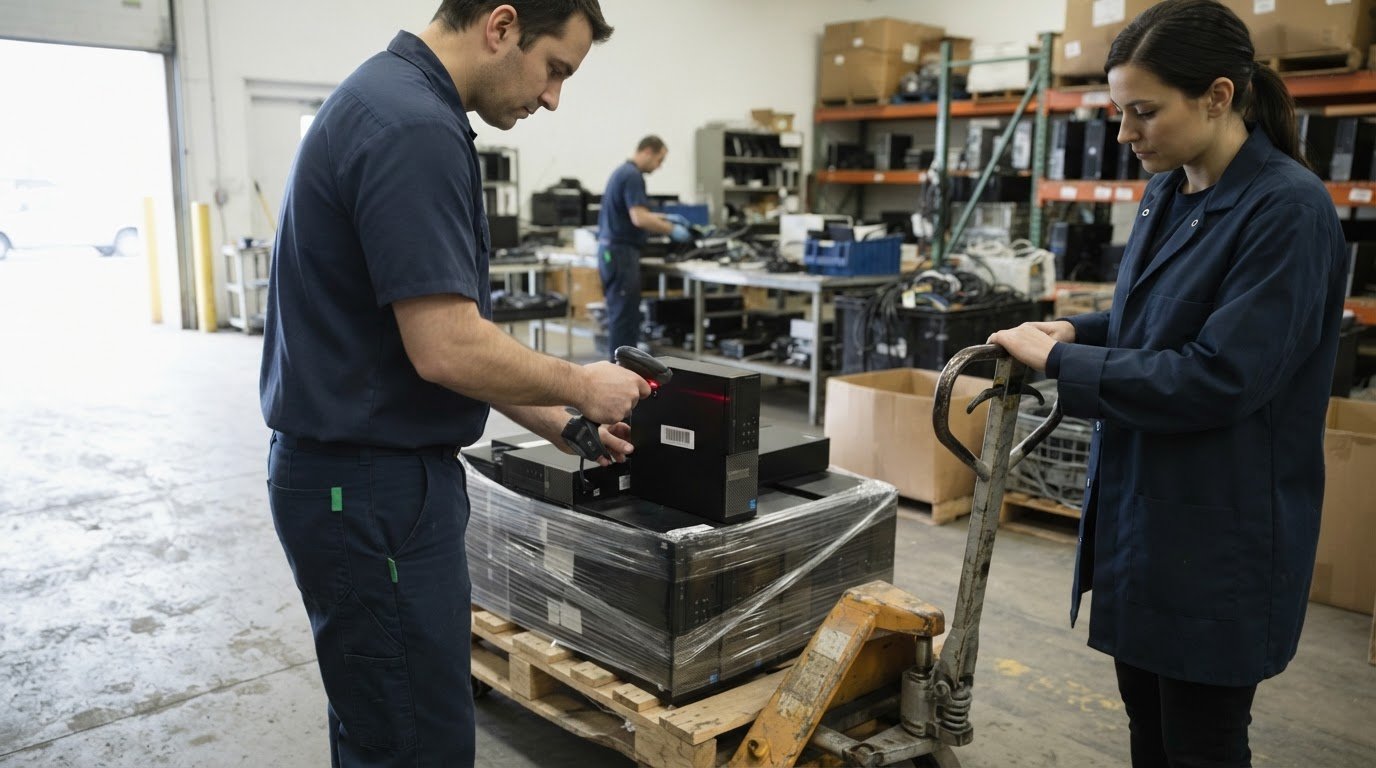
A signed pickup alone cannot account for an asset’s full journey. IT asset disposition chain of custody best practices track each device from retirement to final disposition, recording who handled it, where it moved and what happened to it. At each handoff, match identifiers to a manifest and log the time, condition and sign-off. If counts do not match, document and resolve the discrepancy before the assets move on.
Secure pickup and transport matter, but so does a clear record at every transfer. If an item is missing, delayed or damaged, custody documentation helps pinpoint where the issue occurred. This article explains what to record during collection, transport and processing, how serial numbers and scans help track assets, and how to handle mismatched counts. It also shows how final disposition records connect each device to its outcome, whether it is prepared for reuse, donated, recycled or destroyed.
Key Takeaways
- Set clear handoff roles and keep custody records together so each transfer has an accountable owner.
- When a count is off, pause the next processing step and reconcile the records before moving assets onward.
- Use serial-level scans and a consistent tracking system to follow devices through transport and final disposition.
- Connect each asset’s documented outcome to its original inventory to support governance and audit readiness.
Secure pickup, transport, and handoff records
Record each device’s custody from collection through processing and final disposition. A manifest, transfer sign-offs and outcome evidence make every handoff traceable.
Documented custody handovers
At pickup, the releasing and receiving representatives compare asset counts and identifiers against the manifest. Before the load leaves, they record the time, each person’s identity, the assets’ condition and signatures. Repeat those fields at later transfers, naming the person taking responsibility. This creates evidence for internal reviews and helps identify where an asset went missing, was delayed or arrived damaged.
Secure transport and processing controls
Transport controls can include GPS-monitored vehicles, tamper-evident packaging and handovers between authorized personnel. Before loading, confirm the driver’s name and truck identifier against the shipping record, then log departure, arrival and the receiving person. Seal loose media in containers and check the seals on arrival. During storage and processing, restrict access and log each movement so custody remains documented between checkpoints.
Across transport, storage and processing, the key controls are restricted access, secure loads, documented transfers and recorded receipt. Together, they show who controlled the equipment at each stage.
Disposition transparency and verification
Disposition records link each asset’s identifier to its outcome, such as data destruction, recycling, resale or reuse. Record the data-sanitization method, date and result, and retain the relevant certificate or processing evidence with the asset record. The National Institute of Standards and Technology (NIST) defines media sanitization as making access to target data infeasible for a given level of effort. This definition helps clarify what destruction or wiping evidence needs to demonstrate.
Client and supplier portals can give authorized teams access to shipment status, transfer records and final certificates. Use the final report to reconcile every device against the original manifest and document its disposition. To verify an outcome, link the device identifier to evidence of the completed process instead of relying on a general completion statement.
What happens if asset counts do not match?
Pause processing if counts differ. Document and resolve the discrepancy before assets move on. Controlled reconciliation protects the accuracy of inventory and audit records.
Inventory reconciliation
Inventory reconciliation compares the disposal partner’s receipt report with the site scan list, IT records, facilities lists and equipment physically present. It matters because a mismatch can point to an unrecorded device, an incorrect identifier or an incomplete inventory.
Record a discrepancy as soon as it is found, including the affected device identifiers and the counts in each record. Rescan the physical items and compare serial numbers, not just totals. Check whether equipment was added or removed after the original list was prepared. Keep the processing hold in place until the records and physical count align, or the exception has a documented resolution.
A consistent register also helps teams identify unclear departmental ownership or equipment that was never added to inventory. Record who reviewed the difference, what evidence supported the finding and how the asset record changed. This provides a verified explanation instead of carrying an unexplained count into final reporting.
Audit trails and reporting records
An audit trail brings together asset metadata, access logs, reconciliation decisions and disposition evidence. It supports governance by showing what was reviewed, by whom and at what stage.
Keep the original inventory and site scan list alongside the receipt report, exception notes and updated asset records. Access logs should show who viewed or changed controlled records, while timestamps show when corrections occurred. Preserve the reason for each change so reviewers can distinguish an authorized correction from an unexplained alteration.
A useful reporting pack includes the reconciled inventory, signed manifests, transfer and receiving logs, exception resolutions, and certificates of destruction or recycling. The final disposition report should match each asset’s documented outcome to the original inventory. These records support internal reviews and provide evidence for compliance and audits, rather than relying on a supplier invoice alone.
For equipment entering a documented end-of-life process, electronics pickup and recycling can support a clear disposition record.
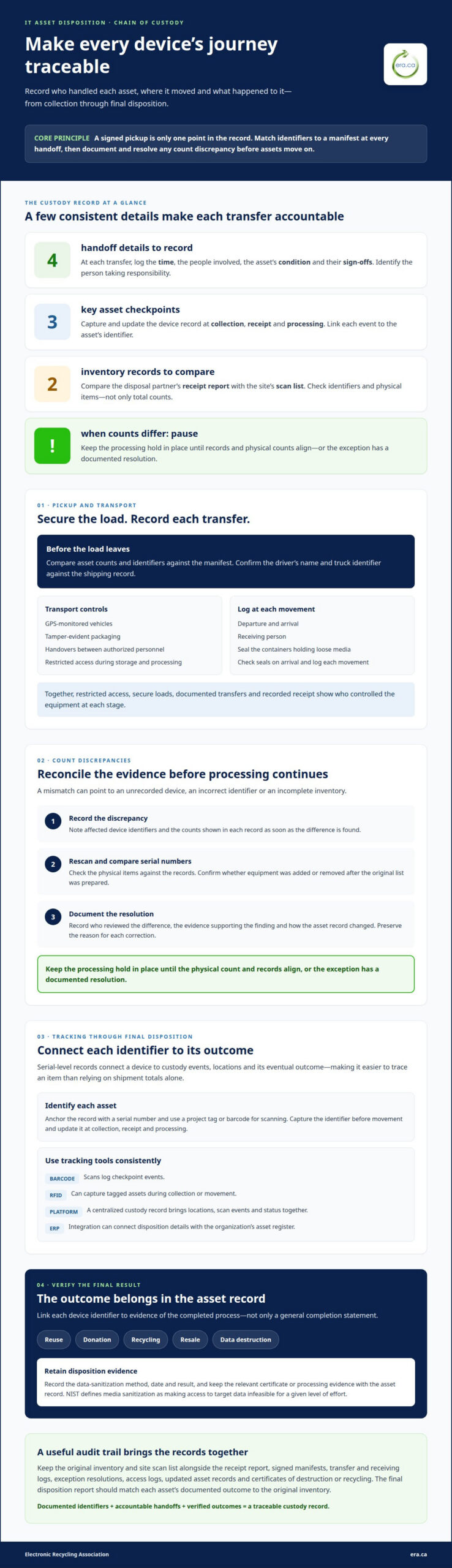
How are assets tracked during disposition and transportation?
Serial-level records connect each device to custody events, locations and its eventual outcome. Consistent identifiers also help teams trace a missing item without relying only on shipment totals.
Asset-level identification and tracking
Asset-level tracking gives each device a record anchored by its serial number, with a project tag or barcode for scanning. Capture the identifier before movement, then update the record at collection, receipt and processing. For example, a laptop’s barcode can link its physical label to its inventory entry even when its storage location changes. This makes similar-looking devices easier to distinguish.
Tracking technologies and platforms
Barcode scans log checkpoint events, while RFID can capture tagged assets during collection or movement. A centralized custody platform brings locations, scan events and status together in one record. ERP integration can connect disposition details with the organization’s asset register, reducing reliance on separate lists that may fall out of sync.
Organizations can apply IT asset disposition chain of custody best practices by standardizing identifiers and recording every tracking event. Technology supports accountability, but consistent records create a useful audit trail.
For Canadian organizations, sanitization methods should align with applicable privacy and sector requirements. NIST SP 800-88 is a relevant media-sanitization reference, according to the National Institute of Standards and Technology (NIST); organizations should also account for applicable Canadian guidance.
Asset tracking and reconciliation
Asset-level tracking makes reconciliation a comparison of identifiable devices, not just shipment totals. Match serial numbers and tags across the site inventory, collection manifest and receiving record. If an item appears in one record but not another, its last scan can help pinpoint where the discrepancy arose.
Keeping identifiers consistent through transport, storage and processing is one of the practical IT asset disposition chain of custody best practices. Connect each scan and status change to the same device record, then link the final outcome to that identifier. This helps teams distinguish a missing asset from a duplicate entry or outdated location.
Asset chain-of-custody fundamentals
A chain of custody accounts for each retired device from release through final disposition. It connects physical handling, asset tracking, data processing and reporting, so records show what happened to equipment and when responsibility changed.
For every asset, retain its identifier, assigned outcome, custody events and processing evidence in one connected record. Outcomes may include reuse, donation, recycling or destruction. This lifecycle view matters because removing equipment from a site is only one step. The organization still needs to account for data-bearing devices through sanitization or physical destruction and document their eventual disposition.
The evidence varies by route. For on-site destruction, record the device identifier, destruction method, date and outcome at the location where the work takes place. For off-site processing, document the transfer, receipt and processing result, linking each event to the same asset record. For resale, retain evidence of data sanitization and record the asset’s subsequent disposition. In every case, document what was done, not merely that the equipment left the site.
Assign named roles for asset release, receipt, processing and exception handling. A senior owner can oversee the process, while internal reviews check whether records match the intended outcome. If a downstream partner handles an asset, continue the custody trail through that transfer. This helps the organization identify where an unresolved gap arose and gather relevant evidence for an audit or incident review.
In Canada, ITAD chain-of-custody service costs depend on the case and are provided after a quote request. Factors include asset volume, handling, transport, data destruction and final disposition. The work required and processing route shape the scope.
For devices requiring documented data destruction, arrange secure data destruction as part of a traceable disposition process.
Electronic Recycling Association (ERA)
The Electronic Recycling Association (ERA) helps organizations move retired electronics toward documented disposition through pickup, secure data destruction, free electronics recycling and charitable computer donations. These services can support a custody process by connecting collection with an appropriate next step, whether devices need data destruction, recycling or reuse through donation.
For a clear handoff, keep asset identifiers and collection records aligned with the devices being released. Make the intended outcome visible in the organization’s records so reporting can account for each item through its disposition. This approach connects practical end-of-life handling with responsible reuse and recycling.
To discuss electronics disposition for your organization, contact the Electronic Recycling Association (ERA).
Make custody part of the next asset cycle
Make disposition controls a standing operational responsibility, not a final administrative task. Assign an internal owner to keep procedures current as teams, sites and asset systems change. A brief review after each cycle can reveal unclear responsibilities or hard-to-use records, giving the organization a chance to refine its process before the next retirement.
Applying IT asset disposition chain of custody best practices consistently also connects asset retirement with broader information-security and environmental goals. Build the process into routine planning so teams understand when disposition begins, who maintains oversight and how outcomes support governance. Keep the procedure clear enough to guide new staff and consistent enough to preserve accountability through organizational changes. This continuity makes responsible asset stewardship part of everyday operations.
For support with your organization’s next disposition, connect with the Electronic Recycling Association (ERA). A considered next step can strengthen your process and support responsible outcomes.
Frequently Asked Questions
Why Poor Chain of Custody is Risky?
Poor custody records make it harder to establish who controlled a device when something goes wrong. For example, if a retired laptop later appears in an unexpected location, incomplete records may leave the organization unable to identify the last responsible handler or determine whether its data was protected. Clear records also help distinguish a genuine loss from an inventory error.
What Is Chain of Custody in Asset Disposition?
In asset disposition, chain of custody is the documented history of control over retired equipment, from the decision to remove it from service through its final outcome. It links an asset to the people and organizations that handled it. For example, an organization should be able to trace a laptop from its department through collection and processing to reuse or destruction.
What is included in a chain-of-custody record?
A useful record includes enough detail to identify the device and explain each custody event. Alongside its serial number, include its make or model, originating department, condition, event time, sender and recipient. Note exceptions when something differs from the plan, such as a damaged casing or a device removed from a collection. This context makes later reviews more useful.
How do organisations maintain chain of custody?
Organizations maintain custody by assigning a process owner and clarifying responsibilities for staff who release, receive or process equipment. Use the same record fields at each site, train staff to log events promptly, and review completed files for omissions. Periodic internal audits can reveal recurring gaps, such as departments retiring equipment without updating their inventory.
What Does Chain of Custody Mean in Legal Contexts?
In a legal context, chain-of-custody documentation can help show how evidence was handled and whether its history is accounted for. For an IT asset, records may be relevant if a device or stored information becomes part of a dispute or investigation. Documentation alone does not determine whether evidence is accepted or establish compliance; those questions depend on the circumstances and applicable Canadian law.
What Happens if the Chain of Custody Is Broken?
A break creates an unexplained gap in an asset’s documented history; it does not automatically prove that a device was accessed or lost. Preserve existing records, identify the last reliably documented event, and investigate the gap before closing the asset file. Record the findings, any impact assessment and corrective action. If sensitive information may be involved, follow the organization’s established incident-response process.