

The lower-carbon IT purchase may be the one an organization can avoid. Scope 3 emissions come from activities across an organization’s upstream and downstream value chain, and the Greenhouse Gas Protocol divides corporate emissions into three scopes. Scope 3 greenhouse gas reductions through hardware refurbishment are possible when refurbished equipment replaces new purchases and extends the useful life of existing devices.
It makes sense to focus on new equipment: manufacturing and delivery can generate emissions beyond an organization’s direct operations. But reuse is only part of the picture. A sound comparison considers the device’s condition and remaining service life, its energy use, and the impacts of refurbishment and transport.
This article explains how refurbishment and reuse may affect Scope 3 emissions, how to compare lifecycle impacts, and which IT purchases may matter most, including user devices, servers and network equipment. It also outlines how to report avoided emissions separately from an organization’s emissions balance. With a clear view of both purchasing and end-of-life choices, IT teams can make practical decisions that support environmental goals while keeping useful equipment in circulation.
Key Takeaways
- Compare refurbished and new equipment across manufacturing, transport, energy use and end-of-life to understand the full lifecycle impact.
- Assess whether extending a device’s useful life can avoid a new purchase without overlooking its condition or energy performance.
- Prioritize IT purchases such as laptops, servers and network equipment by their role in your Scope 3 inventory.
- Classify hardware emissions appropriately and report reuse-related avoided emissions separately from your emissions balance.
Carbon avoidance and comparative life-cycle assessment
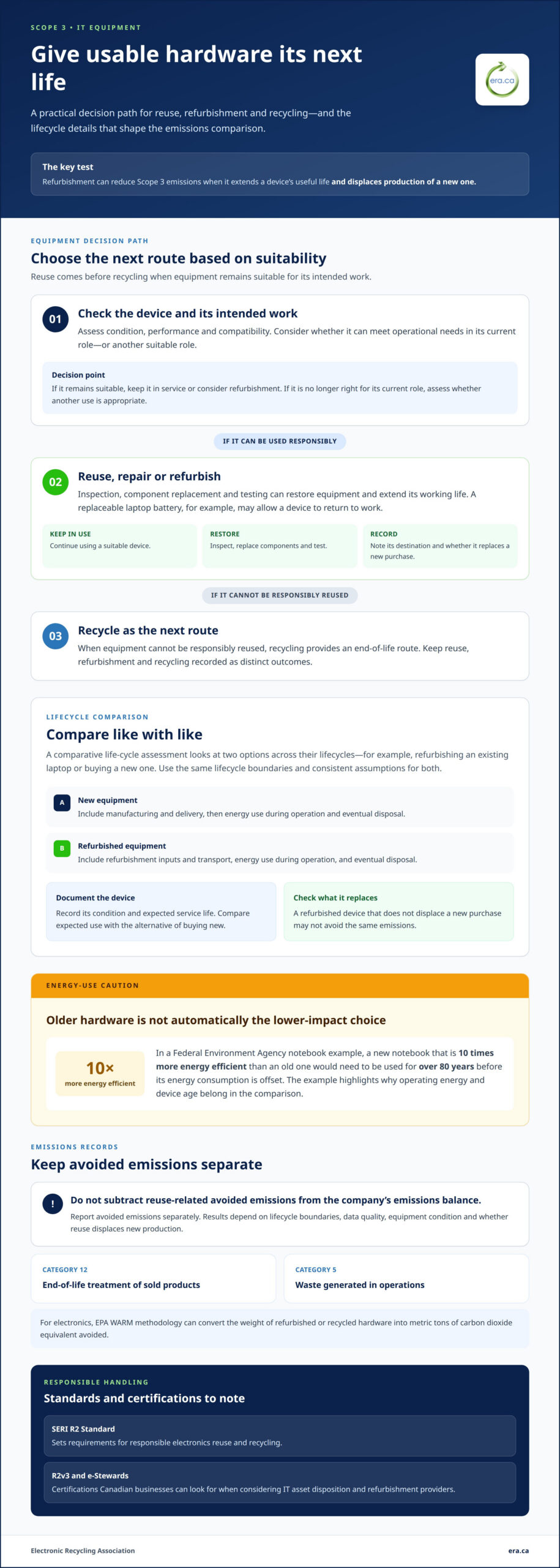
Hardware refurbishment can reduce Scope 3 emissions when it extends a device’s useful life and displaces production of a new one. Compare the equipment’s full lifecycle, including refurbishment, transport, energy use and eventual disposal.
Comparing Emissions Across Product Lifecycles
A comparative life-cycle assessment evaluates the environmental impacts of two options across their lifecycles, such as refurbishing an existing laptop or buying a new one. It matters because the carbon benefit depends on what the refurbished device replaces and how long it remains useful. For organizations pursuing Scope 3 greenhouse gas reductions through hardware refurbishment, define the same lifecycle boundaries for both options before comparing results.
Include the manufacturing and delivery of new equipment, refurbishment inputs, transport, and energy use during operation. Keep assumptions consistent, and document the device’s condition and expected service life. These choices shape the comparison: a refurbished device that does not replace a new purchase may not avoid the same emissions.
Remanufacturing to Extend Asset Life
Remanufacturing restores equipment through inspection, component replacement, and testing, helping extend its working life. Reuse can avoid some emissions associated with producing replacement goods and services while keeping functional assets in circulation. Repair and maintenance can also extend furniture’s life, reducing the need to replace desks, chairs, and other items.
Compare the restored asset’s expected use with the alternative of buying new. Include the materials and transport needed for refurbishment, as well as energy use during operation. A longer service life can strengthen the case for refurbishment, but the comparison should reflect actual operating needs and device performance.
Claims have limits: results depend on lifecycle boundaries, data quality, equipment condition, and whether reuse displaces new production. Report avoided emissions from reuse separately; do not subtract them directly from the company’s emissions balance.
Classify end-of-life emissions according to the activity. Under the GHG Protocol, Category 12 covers end-of-life treatment of sold products, while Category 5 covers waste generated in operations. For electronics, EPA WARM methodology can convert the weight of refurbished or recycled hardware into metric tons of carbon dioxide equivalent avoided.
Canadian businesses seeking certified IT asset disposition and refurbishment providers can look for R2v3 or e-Stewards certification. These are certifications identified for ITAD partners, and they provide a reference point when considering responsible equipment reuse and end-of-life handling.
Hardware refurbishment and reuse as lifecycle considerations
Refurbishment keeps usable electronics in service instead of sending them straight to recycling. A laptop with a replaceable battery, for example, may return to work after inspection and component replacement. Reuse can reduce demand for newly manufactured equipment and the raw materials used in its supply chain. It also preserves more value in the organization’s existing assets.
Reuse should come before recycling when equipment remains suitable for its intended work. A server that still meets operational needs may continue serving the organization after testing and refurbishment. If its performance, condition, or compatibility is no longer suitable, it may have another use. Recycling is the next route when equipment cannot be responsibly reused.
That order matters across the value chain. Manufacturing new devices requires materials and production, while refurbishment involves its own parts and logistics. Consider the specific device and its next use: a laptop may suit a different role after refurbishment, while a server may remain useful for a particular workload. Record the equipment’s destination and whether it replaces a new purchase.
Refurbishment is not automatically the lower-impact choice for every device. A Federal Environment Agency notebook example says a new notebook that is 10 times more energy efficient than an old one would need to be used for over 80 years before its energy consumption is offset. The example shows why operating energy and device age belong in decisions about extending use, alongside manufacturing impacts.
For Canadian businesses, the SERI R2 Standard sets requirements for responsible electronics reuse and recycling. Treat reuse, refurbishment and recycling as distinct outcomes in internal records, since each describes a different route for equipment. When devices reach end of use, free electronics recycling and electronics pickup offer a practical route for responsible handling. Keep records of what was reused and what entered recycling, so reports reflect the equipment’s actual destination.
Materiality and category prioritization
The GHG Protocol maps Scope 3 emissions across 15 categories covering an organization’s upstream and downstream value chain. This framework helps teams organize indirect emissions, identify material activities and decide where refurbishment could influence the carbon footprint. Start with categories connected to equipment purchases, operational waste and products sold.
For purchased office furniture, emissions generally belong in Category 1, purchased goods and services. Furniture discarded from operations can fall under Category 5, waste generated in operations. These categories describe different activities: acquiring a desk and managing its disposal should not be treated as the same source of emissions.
Category 1 measurement can use furniture weight and emission factors for materials such as steel, wood, foam and fabric. For example, a steel filing cabinet and an upholstered chair have different material profiles. Recording furniture type and weight helps organizations calculate purchased-goods emissions more precisely and identify opportunities to maintain, reuse or refurbish existing items.
Category 5 covers waste from operations, including disposal of old equipment. Category 12 instead covers end-of-life treatment of sold products under the GHG Protocol. Choose the category that reflects the equipment’s relationship to the reporting organization: internally used assets sent for disposal differ from products sold to customers and later discarded.
Prioritize categories by considering expected emissions, the organization’s ability to influence reductions, and stakeholder concerns. A category with substantial anticipated emissions may deserve attention, especially when purchasing or end-of-life decisions can make a difference. Review the evidence across categories, then focus measurement on activities where operational decisions can affect outcomes.
This approach also makes reporting more useful. Keep acquisition, operational waste, and sold-product end-of-life records distinct, and document the activity behind each estimate. For example, separating furniture purchases from discarded furniture can clarify where maintenance or reuse may affect future emissions. Revisit category estimates as data and calculation methods improve.
Capital goods and purchased IT equipment
Purchased IT equipment can carry substantial emissions before it reaches an organization. Under the GHG Protocol, Category 2 covers capital goods, including notebooks, PCs, servers and network technology that are activated. It includes cradle-to-gate emissions from equipment a company purchases rather than leases. Manufacturing and delivery of computers can also contribute to emissions from purchased goods and services.
For laptops and smartphones, embodied carbon typically represents 80% to 85% of lifecycle emissions. That makes purchasing decisions and equipment lifespan important sustainability considerations. Assess whether a device can meet business needs for longer before replacing it. Extending use may reduce demand for new manufacturing, although the comparison should account for the existing device’s energy use and condition.
Servers require a different assessment. Their embodied carbon accounts for 20% to 40% of lifecycle impact, so operational energy also matters. In data centres, Scope 3 emissions can include producing, transporting and installing server hardware used by a third-party hosting provider. Network equipment has its own footprint, with typical embodied carbon of 100 to 250 tCO2e per MW.
Improve reporting by separating purchased hardware from equipment used in hosted environments. Record the equipment type, purchase status and relevant lifecycle information. Primary data from manufacturers can make IT hardware emissions measurements more precise. Supplier-specific emission factors can also support assessment, although the available figures indicate only 6% of companies use them.
For global sustainability reporting, connect purchase records with equipment reuse and material recovery information. This can show where purchasing choices affect generated emissions, and where extending an asset’s life may reduce demand for replacement goods. When equipment reaches end of use, arrange electronics pickup for responsible handling as part of its next step.
Electronic Recycling Association (ERA)
The Electronic Recycling Association (ERA) helps Canadian organizations manage surplus equipment that is no longer suitable for continued use. Its services include electronics pickup, free electronics recycling, secure data destruction, and charitable computer donations.
These options support practical end-of-life decisions: equipment that can benefit others may be donated, while devices ready to leave service can be recycled. Secure data destruction also addresses a key operational concern when retiring computers that may contain organizational information. Record equipment destinations to support clear sustainability reporting and distinguish reuse from recycling.
Contact Electronic Recycling Association (ERA) to discuss handling surplus electronics through recycling, secure data destruction, pickup or charitable computer donations.
Make the next equipment decision count
Build lifecycle thinking into future purchasing decisions. Before replacing equipment, consider whether it can continue serving its current role or another organizational need. That simple pause can make Scope 3 greenhouse gas reductions through hardware refurbishment part of routine asset planning, rather than a separate sustainability exercise. It also gives teams an opportunity to connect procurement choices with responsible end-of-use decisions.
For equipment ready to leave service, the Electronic Recycling Association (ERA) offers free electronics recycling, secure data destruction, and electronics pickup. These services help organizations manage retired devices while addressing environmental handling and information security needs. Choose the next step based on whether equipment can be reused or needs recycling, and align the decision with your organization’s reporting approach.
Start with the equipment already on hand. Contact Electronic Recycling Association (ERA) to discuss electronics handling for your organization, and take a practical step towards keeping useful resources in circulation.
Frequently Asked Questions
What are Scope 3 emissions?
Scope 3 emissions are indirect greenhouse gas emissions across an organization’s upstream and downstream value chain. They can arise before a company receives a product, such as during supplier manufacturing, or after a product is sold, through its use and disposal. For example, emissions from outsourced transportation or employee business travel can also fall within Scope 3, depending on the activity and reporting boundary.
Does IT hardware belong to Scope 3?
Yes. Purchased IT hardware can fall under Scope 3, with the category depending on the purchase and the organization’s relationship to the equipment. Activated capital assets such as a purchased server can be reported in Category 2. Hardware discarded from company operations can relate to Category 5, while end-of-life treatment for sold products can relate to Category 12.
Does selling used IT improve my carbon footprint?
Selling used IT does not automatically lower a company’s reported carbon footprint. The environmental benefit depends on whether the next user puts the device to use and whether it replaces a new purchase. Keep records of the equipment sold, its destination, and subsequent reuse where available. Describe avoided emissions separately from the organization’s emissions inventory rather than subtracting them from its footprint.
How can you document IT’s environmental contribution in your annual sustainability report?
Maintain an asset record showing equipment type, weight, condition, and final destination, such as reuse, donation, or recycling. Add refurbishment and transportation information when available, and document the calculation method and emission factors used. For retired electronics, recording the exact weight diverted and grouping materials by type can support clearer reporting. Present reuse-related avoided emissions separately from the emissions inventory.
How are avoided emissions from refurbished hardware calculated using GHG Protocol guidance?
Compare a defined baseline, such as buying new equipment, with the refurbishment and reuse scenario. Use consistent boundaries and account for relevant manufacturing, transport, refurbishment, and operational impacts. The EPA WARM methodology can convert the weight of refurbished or recycled hardware into metric tons of carbon dioxide equivalent avoided. Under the GHG Protocol approach described here, report avoided emissions separately rather than deducting them from the inventory.
What is the lifecycle carbon footprint of refurbished versus new computers and servers?
There is no single lifecycle footprint that applies to every refurbished or new device. The comparison depends on manufacturing impacts, replacement parts, transport, energy use, equipment condition, and time in service. For a computer, assess the expected workload and remaining useful life. For a server, include its operating energy and the work it performs, then compare both options using consistent boundaries and assumptions.